Technique
How to Wrap Your Hands for Boxing
A step-by-step wrap that holds for a full session, plus the 120 vs 180 inch question answered and the three mistakes that make wraps useless.
4 min read
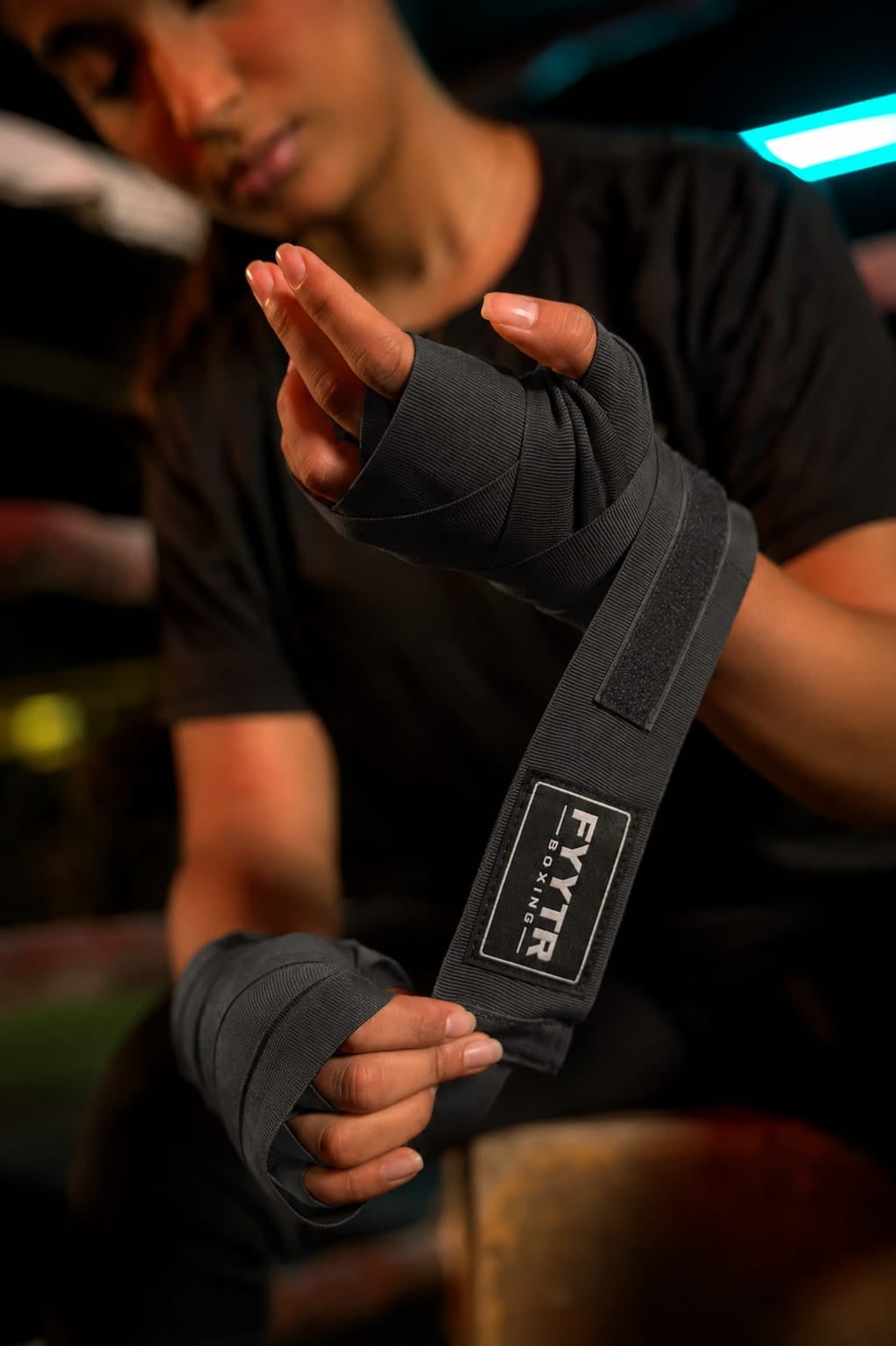
Wrap with your hand open and your fingers spread, anchor at the wrist first, and finish at the wrist. Three passes around the wrist, three around the knuckles, one between each finger, then everything left back onto the wrist. That is a wrap that holds for a full session.
The detail underneath matters, because a wrap that unravels in round three is worse than no wrap at all: it convinces you that you are protected while your wrist moves freely.
120 or 180 inch: pick 180
This is the first decision and most people get it right by accident.
180 inch is the standard for adult hands. It gives you enough material to build real wrist support, put three or four layers across the knuckles, and still have length left to finish properly. If you are hitting the bag hard, doing pad work, or sparring, this is the length you want.
120 inch suits smaller hands, tighter gloves, and light technique work. It is quicker to put on and less bulky inside the glove, which matters if your gloves fit closely. Beginners in fitness classes get on fine with them.
If you are between the two, take 180. You can always use less of it. You cannot use material you do not have. Fairtex reach the same conclusion and so does most of the sport.
Our Laaf wraps are AED 49.
The wrap, step by step
Do this with your hand open and your fingers spread the whole way through. The wrap sets at the width your hand is at when you apply it, so wrapping a closed fist gives you a wrap that strangles an open hand and loosens on a closed one.
- Thumb loop. Hook the loop over your thumb, wrap facing down across the back of your hand.
- Wrist, three times. Straight around, firm and even. This is the foundation and it does most of the work.
- Up to the knuckles, three times. Across the back of the hand, around the knuckles, back down. Keep it flat.
- Between the fingers. From the inside of the wrist, up between little and ring finger, back down. Repeat for each gap, three passes total.
- Back across the knuckles, twice. This locks the finger work in place.
- Diagonals. Two or three passes from the base of the thumb across the back of the hand to the outside of the wrist. This is what stops the wrist folding on impact.
- Finish at the wrist. Use whatever length is left, and fasten.
Make a fist. It should feel like your hand has become one solid unit.
Getting the tension right
Firm at the wrist, lighter over the fingers. That is the whole rule.
The wrist is where you want real support, because a folded wrist is the most common serious hand injury in boxing and it comes from the joint moving under load. The fingers need binding, not compression: they still have to close into a fist inside a glove.
The test takes twenty seconds. Wrap both hands, put your gloves on, and hold a hard fist. If your fingertips go numb or white, or your knuckles feel jammed together, unwrap and redo it with less tension through the wrist passes. Numbness is not something to train through and it will not "settle" once you warm up.
A correct wrap feels supportive and slightly firm at rest, and disappears once you start moving.
Three mistakes that make wraps pointless
Wrapping a closed fist. The most common one. The wrap sets to a closed hand, then either cuts off circulation when you open it or goes slack when you close it. Hand open, fingers spread, every time.
Skipping the diagonals. People run out of patience and finish at the knuckles. The diagonal passes across the back of the hand are what tie the wrist support to the knuckle layer, and without them the two halves work independently.
Wearing them wet. A wrap that went into your bag damp after the last session is a wrap full of bacteria going straight back onto broken skin over your knuckles. This is where gym skin infections come from, and in UAE humidity a bag-left wrap does not dry on its own. Wash after every session, air dry, and own two pairs so you are never forced to reuse.
Why this protects your gloves too
Wraps are usually explained as hand protection, which is only half the reason they exist.
The other half is that a wrap sits between your sweat and your glove lining. Without one, every session soaks foam that is very difficult to dry, especially in a climate where nothing air-dries quickly and gloves live in closed bags. Wet foam compresses faster and holds smell permanently.
A pair of wraps costs AED 49. A pair of training gloves costs AED 199. Wearing the first meaningfully extends the life of the second, which makes wraps the highest-return item in a boxing bag.
If you are still building your kit, what you actually need to start boxing covers the rest in order.
Common questions
180 inch for most adults. It gives enough material for proper wrist support and knuckle layers. 120 inch suits smaller hands, tighter gloves and light technique work.
Firm, not tight. Wrap with your hand open and fingers spread, then make a fist. If your fingertips tingle or go white, unwrap and start again with less tension at the wrist.
Yes. Bag work is where most hand injuries happen, because you hit a hard surface repeatedly without the give of a moving target.
After every session. They hold sweat by design, and unwashed wraps are the usual cause of skin problems and glove smell.
You can, but you should not. Wraps support the wrist, bind the small bones of the hand, and absorb the sweat that would otherwise destroy your glove lining.
Shop the kit

Keep reading

Technique4 min read
Boxing Combinations for Beginners: The Punch Numbers
The six punch numbers boxing coaches call, the first combinations to learn, how to drill them shadow boxing and on pads, and the mistakes that slow beginners.

Technique4 min read
Boxing Footwork Drills You Can Do Anywhere
The boxing stance, the four basic steps and the pivot, plus five footwork drills that need only floor space, and how often a beginner should practise them.
Training3 min read
Amateur Boxing Kit: What to Bring to a Bout
What to pack for your first amateur boxing bout in the UAE, what the show usually supplies, what has to be yours, and what to confirm before fight day.